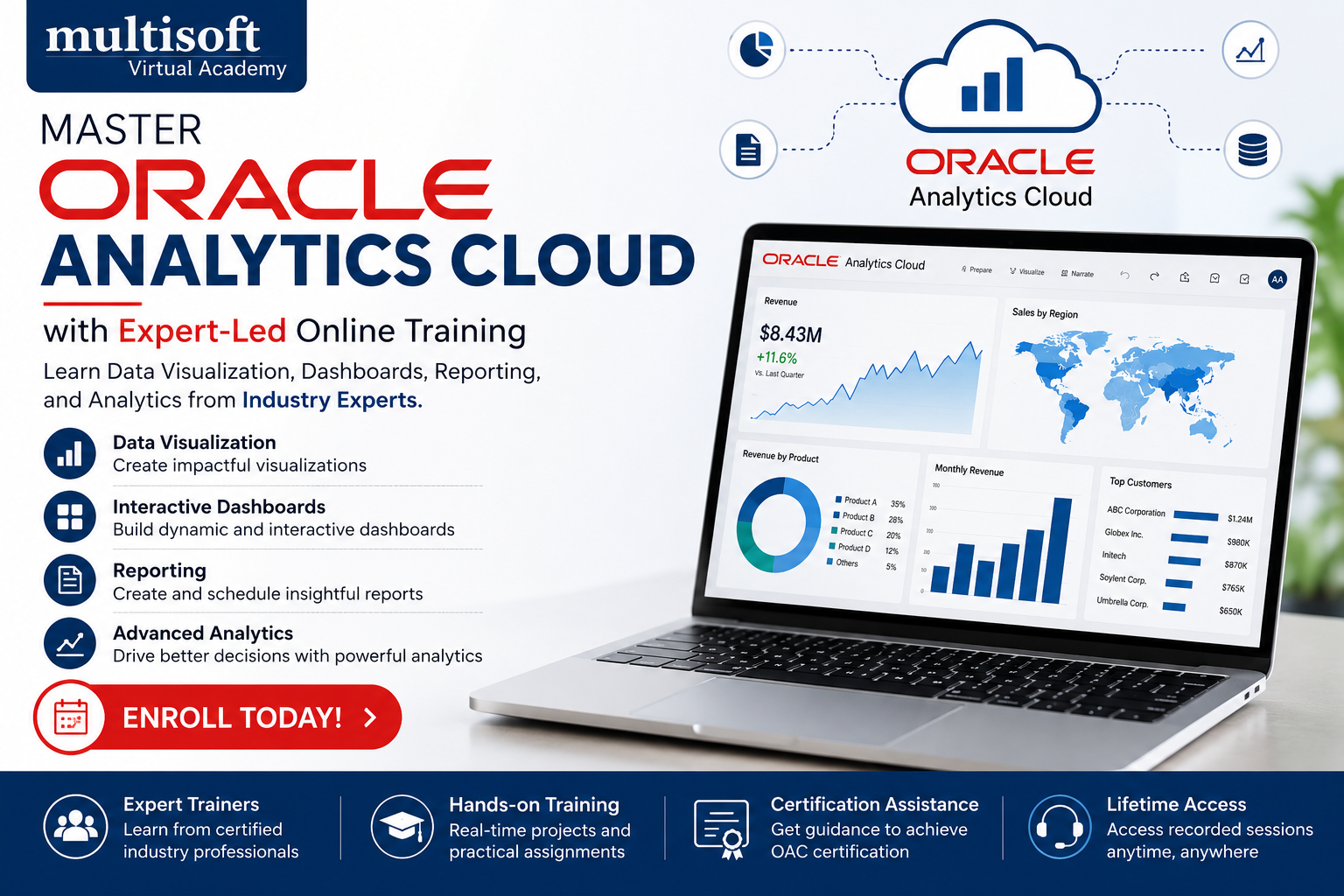
In today’s data-driven business environment, organizations require intelligent platforms that can transform raw data into meaningful insights. Businesses generate massive volumes of structured and unstructured data from ERP systems, CRM platforms, IoT devices, cloud applications, and enterprise databases. Traditional reporting tools are often unable to handle the speed, scale, and complexity of modern analytics requirements. This is where Oracle Analytics Cloud (OAC) becomes a powerful solution.
Oracle Analytics Cloud is a comprehensive cloud-based analytics and business intelligence platform developed by Oracle. It enables organizations to prepare data, visualize information, generate reports, build dashboards, and apply machine learning-driven analytics within a unified environment. OAC combines data integration, artificial intelligence, natural language processing, self-service analytics, and enterprise reporting capabilities into a single scalable platform. The platform is designed for business users, analysts, data engineers, and executives who require fast and intelligent access to enterprise insights. Oracle Analytics Cloud supports data discovery, predictive analytics, augmented analytics, mobile analytics, and embedded business intelligence. Organizations across industries such as finance, healthcare, manufacturing, retail, telecom, and government use OAC to improve operational efficiency, strategic planning, and decision-making.
With cloud-native architecture, advanced visualization features, and AI-powered capabilities, Oracle Analytics Cloud online training helps enterprises modernize their analytics ecosystem while reducing infrastructure complexity and maintenance costs.
Oracle Analytics Cloud evolved from Oracle’s earlier business intelligence technologies such as Oracle BI Enterprise Edition (OBIEE). As organizations shifted toward cloud computing and digital transformation, Oracle introduced OAC as a next-generation analytics platform that could deliver scalable and intelligent business analytics through the cloud. The transition from on-premises analytics systems to cloud-based platforms offered several advantages:
Oracle Analytics Cloud integrates the capabilities of traditional BI systems with modern cloud analytics technologies. It combines data visualization, enterprise reporting, machine learning, and AI-assisted insights into a unified solution accessible through web browsers and mobile devices.
Today, OAC is considered one of Oracle’s strategic cloud services supporting enterprise digital transformation initiatives.
1. Self-Service Data Visualization
Oracle Analytics Cloud allows users to create interactive dashboards and visual reports without extensive technical knowledge. Users can drag and drop data elements to build charts, graphs, maps, KPIs, and scorecards. The platform supports multiple visualization types including:
These visualizations help organizations identify trends, patterns, anomalies, and business opportunities quickly.
2. AI-Powered Analytics
One of the most advanced capabilities of Oracle Analytics Cloud training is its AI-driven analytics engine. OAC uses machine learning and augmented analytics to automate data discovery and insight generation. AI-powered capabilities include:
Users can ask business questions in simple language, and the system generates relevant visual reports automatically.
3. Data Preparation and Integration
Data preparation is essential for accurate analytics. Oracle Analytics Cloud provides built-in tools for cleansing, transforming, and enriching data before analysis. The platform supports integration with:
Users can combine data from multiple sources into a unified analytical model.
4. Enterprise Reporting
OAC includes robust enterprise reporting capabilities for operational and strategic reporting requirements. Organizations can generate:
Reports can be exported in formats such as PDF, Excel, PowerPoint, and CSV.
5. Mobile Analytics
Oracle Analytics Cloud provides mobile-friendly dashboards and analytics interfaces that allow users to access reports from smartphones and tablets. Executives and managers can monitor business performance in real time while traveling or working remotely.
6. Embedded Analytics
Organizations can embed Oracle Analytics dashboards into enterprise applications, customer portals, or websites. This enables contextual analytics directly within business workflows. Embedded analytics improves user productivity by reducing the need to switch between applications.
Oracle Analytics Cloud (OAC) is built on a modern cloud-native architecture designed to deliver scalable, secure, and intelligent analytics capabilities for enterprises. The architecture integrates data management, analytics processing, visualization, and security into a unified framework that supports real-time business intelligence and advanced analytical operations.
Another important component is the Security and Governance Layer. Oracle Analytics Cloud includes enterprise-grade security features such as role-based access control, identity management, encryption, auditing, and single sign-on capabilities. These mechanisms ensure secure data access, compliance management, and governance across organizational environments.
Together, these architectural layers create a powerful analytics ecosystem that supports enterprise intelligence, operational reporting, and data-driven decision-making in modern cloud environments.
Oracle Analytics Cloud follows a structured workflow that transforms raw enterprise data into actionable insights.
Step 1: Data Collection
The platform connects to various enterprise data sources including ERP systems, databases, cloud applications, and spreadsheets. Data can be imported in real time or through scheduled synchronization processes.
Step 2: Data Preparation
Raw data is cleaned, filtered, transformed, and organized for analysis. Users can:
This step ensures data quality and accuracy.
Step 3: Data Modeling
After preparation, users create logical relationships between datasets. Data modeling includes:
Proper modeling improves reporting efficiency and analytical accuracy.
Step 4: Visualization and Reporting
Users build dashboards and reports using drag-and-drop functionality. Visualizations help users:
Interactive dashboards enable drill-down analysis for deeper insights.
Step 5: AI and Predictive Analytics
Oracle Analytics Cloud applies machine learning algorithms to identify trends and generate predictions. The system can:
These capabilities support proactive decision-making.
Step 6: Collaboration and Sharing
Reports and dashboards can be shared across departments and teams. Users can:
This improves enterprise-wide data accessibility.
Benefits
Oracle Analytics Cloud is widely used across industries to improve decision-making, operational efficiency, and business intelligence capabilities. In the banking and financial sector, organizations use it for fraud detection, financial forecasting, customer analytics, risk management, and regulatory reporting. Healthcare institutions apply Oracle Analytics Cloud for patient data analysis, resource planning, treatment optimization, and operational monitoring. Retail and e-commerce companies leverage the platform to analyze customer behavior, optimize inventory, forecast demand, and improve personalized marketing strategies. Manufacturing industries use Oracle Analytics Cloud for supply chain analytics, predictive maintenance, production monitoring, and quality control management. Telecommunications companies utilize it for network performance analysis, customer churn prediction, and service optimization. Educational institutions use the platform to analyze student performance and operational data. Government organizations implement Oracle Analytics Cloud for policy analysis, citizen service improvement, and resource management. Its AI-driven analytics and real-time reporting capabilities make it valuable for organizations seeking intelligent, data-driven business transformation.
Traditional BI systems often require extensive hardware infrastructure, manual upgrades, and technical expertise. Oracle Analytics Cloud offers several advantages over legacy analytics solutions.
| Feature | Traditional BI Tools | Oracle Analytics Cloud |
|---|---|---|
| Deployment | On-premises | Cloud-based |
| Scalability | Limited | Highly scalable |
| Upgrades | Manual | Automatic |
| AI Capabilities | Limited | Advanced AI/ML |
| Accessibility | Restricted | Anywhere access |
| Infrastructure Cost | High | Lower |
| Mobile Support | Basic | Advanced |
| Integration | Complex | Simplified |
OAC modernizes enterprise analytics by combining flexibility, scalability, and intelligence.
Despite its advanced capabilities, Oracle Analytics Cloud presents several implementation and operational challenges for organizations. Integrating data from multiple enterprise systems can become complex, especially when dealing with legacy applications and inconsistent data formats. Large-scale analytics projects may require skilled professionals with expertise in cloud analytics, data modeling, and Oracle technologies. Performance optimization can also become challenging when handling massive datasets, complex dashboards, or real-time analytics workloads. Organizations must establish proper data governance and security policies to maintain compliance and data accuracy. User adoption may require training because advanced analytical features and AI-driven tools can involve a learning curve for business users. Additionally, customization and integration with non-Oracle environments may sometimes increase implementation effort, project timelines, and overall operational costs for enterprises.
Oracle Analytics Cloud continues to evolve with emerging technologies and business intelligence innovations. Future trends include:
As organizations continue digital transformation initiatives, analytics platforms like OAC will play a critical role in enterprise intelligence strategies.
The growing adoption of cloud analytics platforms has increased demand for Oracle Analytics Cloud professionals. Popular job roles include:
Professionals with expertise in Oracle cloud technologies, data modeling, visualization, SQL, and machine learning can build rewarding careers in this domain.
Oracle Analytics Cloud is a powerful enterprise analytics platform that combines business intelligence, data visualization, AI-powered analytics, and cloud scalability into a unified solution. It enables organizations to transform raw enterprise data into meaningful insights for strategic decision-making. With features such as self-service analytics, predictive intelligence, mobile reporting, embedded dashboards, and machine learning integration, OAC supports modern digital business requirements across industries. Its cloud-native architecture reduces infrastructure complexity while improving scalability, accessibility, and operational efficiency.
As businesses continue to rely on data-driven strategies, Oracle Analytics Cloud is becoming an essential technology for enterprises seeking intelligent analytics, operational visibility, and competitive advantage. Organizations adopting OAC can improve performance, optimize operations, and unlock deeper business insights in an increasingly digital world. Enroll in Multisoft Virtual Academy now!
| Start Date | End Date | No. of Hrs | Time (IST) | Day | |
|---|---|---|---|---|---|
| No schedule available ! | |||||
Schedule does not suit you, Schedule Now! | Want to take one-on-one training, Enquiry Now! |
|||||






 Join our Live Instructor-Led online classes delivered by industry experts
 Let's Get Started