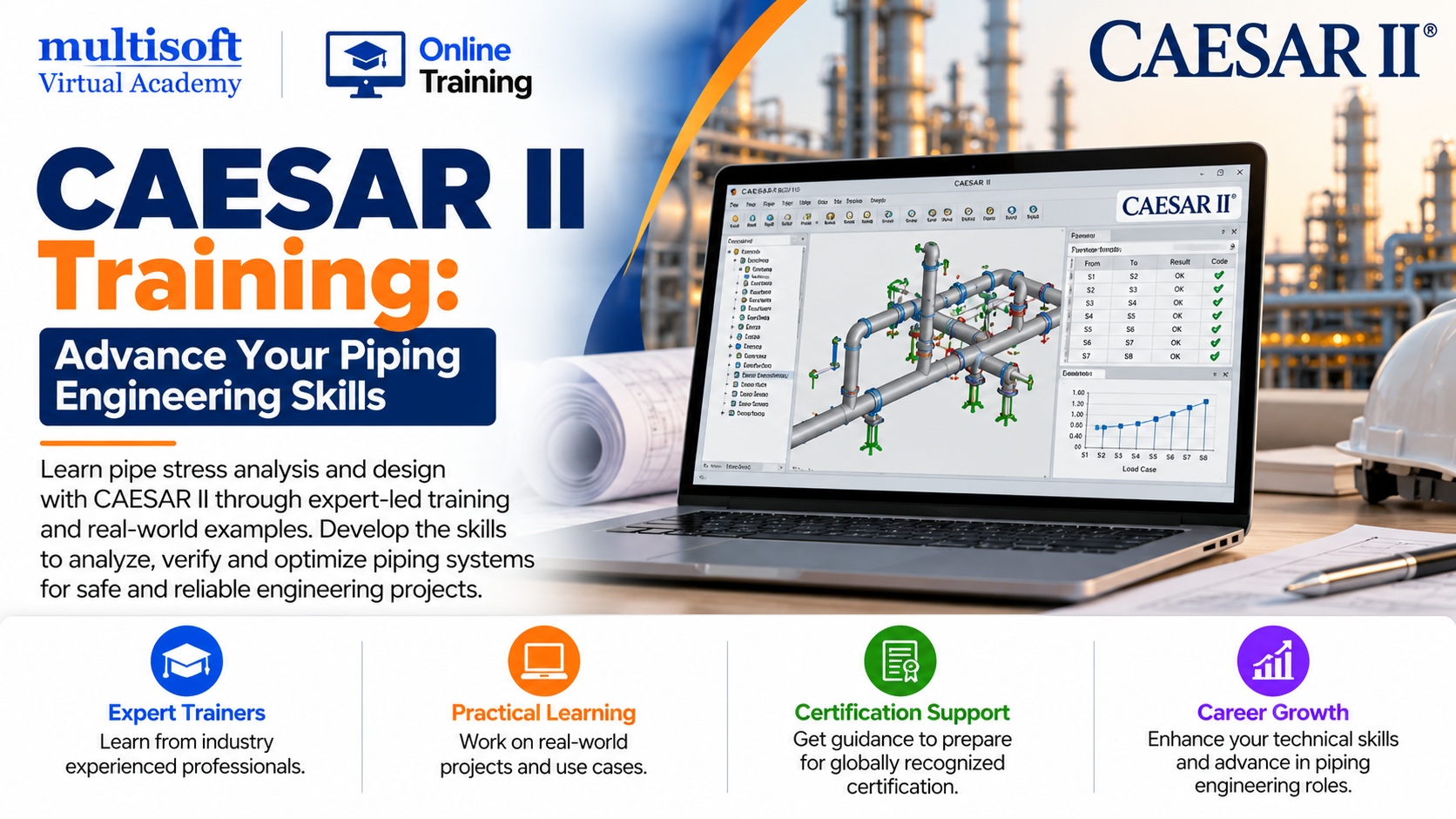
Industrial piping systems must withstand pressure, temperature changes, equipment movement, vibration, and environmental loads throughout their operating life. Designing these systems requires more than selecting pipe sizes and arranging components. Engineers must also evaluate stress levels, thermal expansion, support reactions, and the forces transferred to connected equipment.
CAESAR II Training helps mechanical engineers, piping designers, and stress analysis professionals learn how to model piping systems, evaluate their behavior, and interpret engineering results using specialized software. Through a combination of theoretical concepts and practical exercises, learners can develop an understanding of piping flexibility, load combinations, stress calculations, and code-based assessment.
For professionals working in oil and gas, power generation, chemical processing, and EPC projects, this training can strengthen technical capabilities relevant to piping design and mechanical integrity.
CAESAR II is piping stress analysis software originally developed by Hexagon. It enables engineers to create analytical models of piping systems, define operating conditions, perform static and dynamic analyses, and review calculated stresses, displacements, and support loads.
The software also supports comparisons against applicable piping code requirements and engineering limits. Its capabilities can be used when designing new piping systems, modifying existing installations, or investigating unexpected operating conditions.
For example, consider a steam pipeline operating at an elevated temperature. As the pipe heats up, it expands. If the system does not have sufficient flexibility, the resulting forces may affect supports, connected equipment, and other piping components.
A piping stress engineer uses analytical methods to assess these effects and determine whether the design satisfies the relevant requirements. CAESAR II supports this process by allowing engineers to evaluate different loading conditions and review their effects on the piping model.
Successful analysis depends on correct input data, suitable modeling assumptions, and an engineer's ability to interpret the results.
Piping flexibility describes a system's ability to accommodate movement without developing unacceptable stresses or loads. Engineers consider routing, bends, offsets, supports, and other design features when evaluating flexibility.
Training introduces learners to these concepts and explains how the software can help evaluate piping arrangements under different operating conditions.
Piping stress analysis involves evaluating the effects of weight, pressure, thermal expansion, and other specified loads. Learners can develop an understanding of how these conditions influence calculated stress values and displacements.
This knowledge is useful for reviewing design alternatives and identifying areas that require further investigation.
An accurate model is essential for meaningful analysis. Training helps participants understand how to enter piping geometry, assign material properties, define components, and establish support conditions.
Practical exercises also help learners identify connectivity issues, incorrect input values, and modeling assumptions that could affect results.
Analysis results can reveal potential concerns such as excessive displacement, high support reactions, or stress values above applicable limits. Understanding these results helps engineers investigate possible causes and evaluate design modifications.
The objective is not simply to obtain a passing result. It is to develop a piping arrangement that meets applicable engineering requirements while remaining practical to construct and operate.
A comprehensive CAESAR II Training Course should cover the fundamentals of piping stress analysis before progressing to more complex software functions.
Learners begin with concepts such as stress, strain, material properties, thermal expansion, flexibility, and allowable stress.
The course may also explain the differences between sustained, expansion, and occasional loading conditions. Understanding these concepts makes it easier to interpret software output and recognize why a piping system may require design changes.
Model development involves translating engineering drawings and project data into an analytical representation.
Training may include:
These skills help participants understand how the analytical model represents the physical piping system.
Static analysis evaluates the piping system under specified loading conditions. It is commonly used to assess weight, pressure, thermal expansion, and other relevant loads.
A practical course may demonstrate how to create load cases, execute an analysis, review calculated stresses, and investigate unexpected results.
Learners should understand that the correct analysis procedure depends on the applicable piping code and the project's design criteria.
Different operating and environmental conditions can affect piping systems in different ways. Engineers must identify which conditions need to be evaluated and determine how they should be combined.
Training may cover sustained loads, operating conditions, thermal expansion cases, occasional loads, and relevant combinations.
The selection of load cases should follow the applicable code and project requirements rather than relying on a generic combination for every system.
Supports control piping movement and transfer loads to surrounding structures. Their placement and behavior influence system flexibility and stress distribution.
Training may introduce anchors, guides, line stops, directional restraints, spring supports, and other restraint types.
Learners can explore how changes in support locations or boundary conditions affect displacements and reaction forces. Support decisions should always consider the complete piping arrangement and the relevant structural requirements.
Piping stress analysis is performed against applicable engineering codes and standards. Depending on the application, these may include ASME B31.3 for process piping and ASME B31.1 for power piping.
Training helps learners understand how software calculations relate to code-defined stress limits, allowable values, and analysis requirements.
The governing code edition should be confirmed for every project. A software report alone does not establish compliance without appropriate engineering review.
Piping systems connected to pumps, compressors, turbines, vessels, and heat exchangers can transfer forces and moments to equipment nozzles.
Excessive loads may require further investigation because connected equipment has its own design limitations.
Training may introduce nozzle load assessment, equipment-related output, and the process of comparing calculated loads with applicable manufacturer or project criteria.
Some systems experience dynamic loads that cannot be adequately evaluated through static analysis alone. Examples include vibration, pressure transients, seismic excitation, and other time-dependent events.
Advanced training may cover modal analysis, harmonic analysis, response spectrum methods, and time-history analysis. These topics generally require a stronger foundation in piping mechanics and static stress analysis.
The need for dynamic analysis depends on the system, loading conditions, project requirements, and engineering assessment.
CAESAR II skills can be relevant wherever piping systems must be assessed for mechanical behavior and operating loads.
Oil and gas: Engineers may analyze process piping, utility lines, offshore piping, and equipment connections.
Petrochemical facilities: Stress analysis helps evaluate piping exposed to elevated temperatures, pressure changes, and demanding operating conditions.
Power plants: Steam and other power-related piping systems may require detailed flexibility and stress assessments.
Chemical processing: Piping arrangements must be evaluated according to their operating conditions, material requirements, and applicable design codes.
EPC companies: Engineering teams use stress analysis to support design reviews, coordinate piping layouts, investigate design concerns, and prepare technical reports.
Industrial facilities: Existing piping systems may require analysis when equipment changes, operating conditions are modified, or plant expansions introduce new design requirements.
The specific application depends on the project scope, engineering standards, and the capabilities required by the organization.
Learning the complete analysis workflow helps participants connect individual software functions to real engineering tasks.
Engineers review piping layouts, isometric drawings, material specifications, equipment data, and operating conditions. This information provides the foundation for building an analytical model.
The piping arrangement is represented in the software using geometry, components, materials, and boundary conditions.
The model should reflect the actual design and include the details necessary for the intended assessment.
Engineers identify relevant pressure, temperature, weight, wind, seismic, and other applicable loads.
Load cases and combinations are established according to the governing code and project-specific requirements.
The model is checked for input errors and connectivity problems before the analysis is executed. The engineer then reviews the calculated stresses, displacements, and support reactions.
Results that exceed applicable limits or appear inconsistent with expected system behavior must be investigated.
Potential causes may include incorrect input data, unrealistic support assumptions, inadequate flexibility, or other design issues.
If necessary, the engineer evaluates changes to the piping layout, support arrangement, or other relevant design parameters.
The revised model must be analyzed again to determine whether the changes address the original concern without creating new problems.
Engineering reports document the analysis assumptions, loading conditions, results, and conclusions. Clear reporting helps reviewers understand the assessment and supports project documentation.
CAESAR II training may suit professionals who work with piping design, mechanical engineering, or stress analysis.
Basic familiarity with engineering drawings, piping components, and mechanical principles is beneficial. Beginners should choose a course that explains fundamental concepts before introducing advanced analysis.
Developing CAESAR II skills can complement professional experience in piping and mechanical engineering. Depending on qualifications and practical ability, relevant career paths may include:
Training can help candidates develop software familiarity and a better understanding of analysis procedures. However, employers may also require practical project experience, knowledge of applicable codes, problem-solving skills, and the ability to prepare and explain technical reports.
Completing a course does not guarantee employment or qualify someone to approve engineering designs independently.
Before enrolling in CAESAR II Online Training, evaluate the curriculum and practical learning opportunities.
Check the syllabus: Confirm that the course covers model creation, static analysis, load cases, supports, stress evaluation, and reporting.
Look for practical exercises: Hands-on assignments can help learners understand how the software is applied to typical piping problems.
Review trainer experience: An instructor with relevant engineering knowledge can explain both software operations and the reasoning behind analysis decisions.
Confirm software access: Ask which version is used and whether participants can practice with the software during training.
Evaluate advanced topics: If your objectives include dynamic analysis, nozzle loads, or complex support systems, confirm that these subjects are included.
Clarify certification: Check whether the course provides a completion certificate or prepares learners for a separate certification process.
A suitable course should align with your experience, learning goals, and the type of piping engineering work you intend to pursue.
CAESAR II Training teaches participants to model piping systems, define loading conditions, perform stress analysis, evaluate support reactions, and interpret results using piping stress analysis software.
The difficulty depends on your engineering background. Understanding piping components, material behavior, and stress analysis fundamentals can make the software easier to learn.
Common topics include piping model development, static analysis, thermal expansion, load combinations, support evaluation, code compliance, output interpretation, and reporting. Advanced programs may include dynamic analysis.
Piping stress analysis is relevant to oil and gas, petrochemicals, power generation, chemical processing, and other industrial sectors.
No. Training can strengthen relevant technical skills, but employment depends on qualifications, experience, practical competence, and employer requirements.
Piping design focuses on system layout, components, and specifications. Stress analysis evaluates how the piping system responds to loads and movement and whether it satisfies applicable engineering criteria.
CAESAR II supports engineers in evaluating piping systems under thermal, pressure, weight, and environmental loads. Developing practical knowledge of model creation, load combinations, support behavior, code compliance, and result interpretation can help professionals strengthen their piping engineering capabilities. A well-designed learning program should combine software exercises with sound engineering principles and realistic analysis scenarios. Multisoft Virtual Academy offers CAESAR II Training for professionals who want to develop their piping stress analysis knowledge and prepare for technical responsibilities in industrial engineering projects.
| Start Date | End Date | No. of Hrs | Time (IST) | Day | |
|---|---|---|---|---|---|
| No schedule available ! | |||||
Schedule does not suit you, Schedule Now! | Want to take one-on-one training, Enquiry Now! |
|||||




 Join our Live Instructor-Led online classes delivered by industry experts
 Let's Get Started
