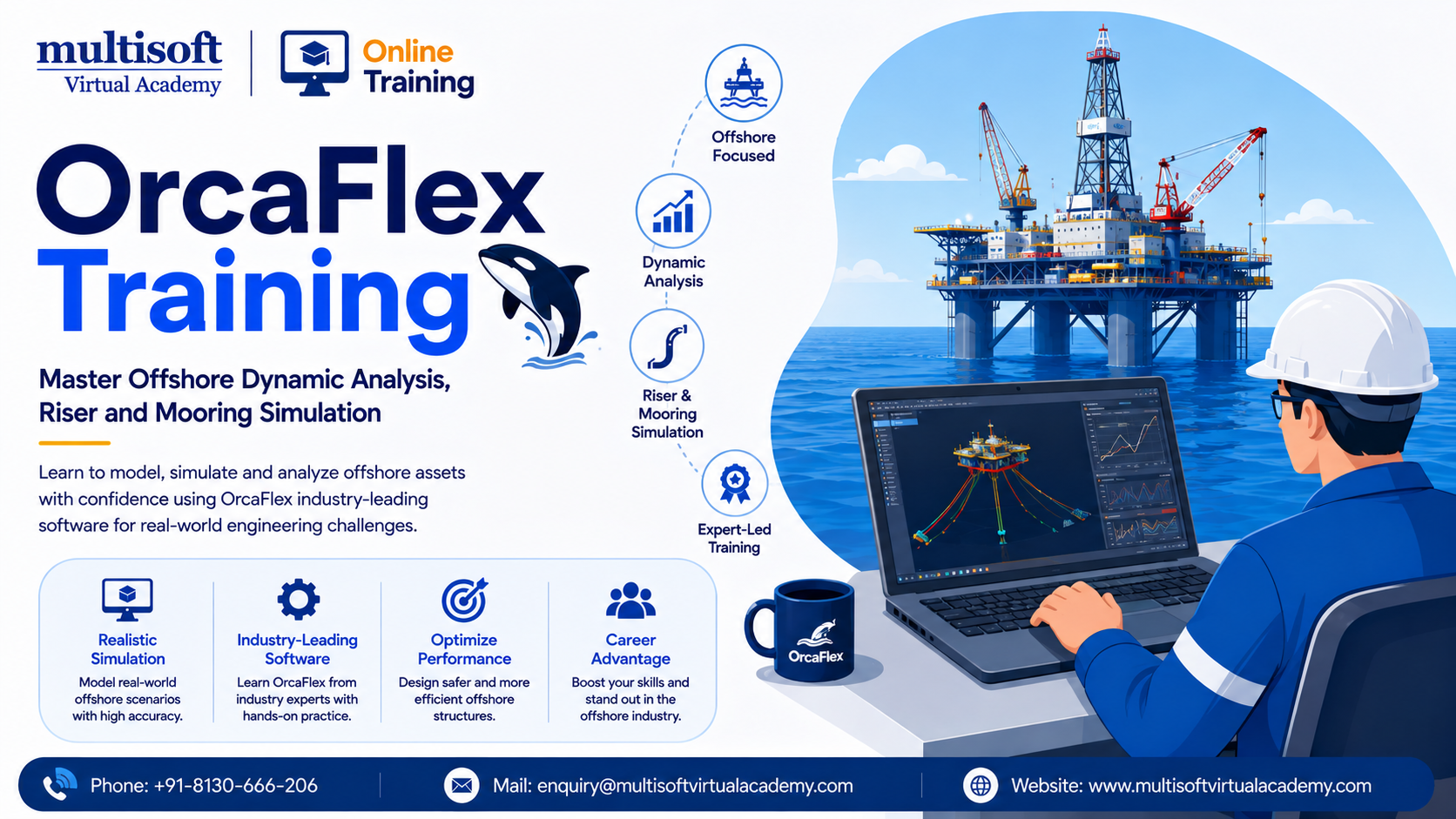
The offshore engineering industry increasingly relies on advanced simulation tools to design, analyse and validate complex marine systems. As offshore projects move into deeper waters and more challenging environments, engineers need specialized software skills to evaluate structural behaviour, hydrodynamic forces, vessel motions, mooring systems and subsea equipment with greater accuracy. OrcaFlex Training provides professionals with the practical knowledge required to use OrcaFlex for advanced offshore engineering and marine dynamics applications.
OrcaFlex is widely used for the analysis of offshore structures, risers, cables, pipelines, mooring systems and marine operations. Learning how to create models, define environmental conditions, configure vessels and interpret simulation results can help engineers improve their technical capabilities and make better engineering decisions.
An effective OrcaFlex Training should go beyond basic software navigation. It should introduce participants to modelling principles, dynamic analysis, environmental loading, simulation techniques and result interpretation. With practical exercises and real-world engineering scenarios, professionals can develop skills that are relevant to offshore design, installation, transportation and operational analysis.
OrcaFlex is a marine dynamics simulation software application used to model the behaviour of offshore systems under different environmental and operational conditions. It can be applied to static and dynamic analysis involving structures such as risers, mooring lines, cables, pipelines and other flexible marine components.
The software enables engineers to represent complex offshore systems and investigate how they respond to waves, currents, vessel motion, wind and other environmental factors. This makes OrcaFlex Software Training particularly useful for professionals working in offshore engineering, subsea engineering, naval architecture and marine operations.
Understanding the fundamentals of the software is important because accurate results depend on appropriate model configuration, reliable input data and sound engineering assumptions.
Offshore projects involve significant technical and environmental uncertainties. Engineers must understand how marine structures behave under changing operating conditions and how different components interact within an offshore system.
Professional OrcaFlex Training can help learners develop capabilities in areas such as:
Instead of relying only on theoretical knowledge, participants can learn how to apply engineering concepts within a simulation environment.
This practical approach can be valuable for engineers who want to improve their ability to assess offshore systems before physical installation or operation.
OrcaFlex supports a wide range of offshore and marine engineering applications. Its versatility makes it relevant to several engineering disciplines and project stages.
Risers are critical components connecting subsea systems with floating or fixed offshore facilities. Their behaviour can be influenced by vessel motion, waves, current, internal contents and environmental loading.
OrcaFlex Riser Analysis helps engineers investigate riser response and evaluate parameters such as tension, curvature, displacement and dynamic behaviour.
Engineers can use simulation studies to examine different operating conditions and identify potential design concerns before implementation.
Mooring systems help maintain the position of floating offshore facilities and vessels. Their performance is affected by environmental conditions, line properties, vessel motions and system configuration.
OrcaFlex Mooring Analysis allows engineers to model mooring lines and investigate their response under different environmental and operational scenarios.
Understanding mooring behaviour is particularly important for floating production systems, offshore platforms, floating wind installations and marine vessels.
Subsea cables are used across offshore energy and marine infrastructure projects. Their mechanical response can be affected by installation configuration, seabed interaction, environmental loads and vessel movement.
OrcaFlex can be used to simulate cable behaviour and evaluate parameters such as tension, curvature and displacement.
Offshore pipelines can experience complex loading conditions during installation and operation. Dynamic simulation can assist engineers in understanding pipeline behaviour under different scenarios.
OrcaFlex-based modelling can support studies involving pipeline installation, movement and interaction with other offshore systems.
A comprehensive OrcaFlex Course generally combines software fundamentals with engineering applications. The exact curriculum can vary depending on the learner's experience and professional requirements.
A structured program may cover the following areas:
Participants can begin by learning the software environment, model structure, object definitions and fundamental configuration processes.
This stage provides the foundation required to create reliable simulation models.
Learners can explore how to define vessels, lines, buoys, constraints and other relevant objects. They can also understand how object properties influence simulation results.
Offshore systems operate in constantly changing environments. Therefore, training can cover the definition of waves, currents, wind and other environmental parameters.
Understanding environmental inputs is essential for producing meaningful simulations.
Static analysis provides an important starting point for many offshore models. Participants can learn how to establish equilibrium and review the resulting configuration before performing dynamic simulations.
OrcaFlex Dynamic Analysis is one of the most important areas for offshore engineers. Training can introduce time-domain simulations and help learners understand how systems respond to changing environmental and operational conditions.
Generating simulation results is only one part of engineering analysis. Professionals also need to understand what those results mean.
Training can introduce result graphs, time histories, statistical outputs and other analytical information that can assist in engineering evaluation.
Modern professionals often need flexible learning options that fit around project schedules and workplace responsibilities. OrcaFlex Online Training can provide an accessible way to develop software and engineering skills without requiring learners to attend traditional classroom sessions.
Online learning can offer several advantages:
For working engineers, this flexibility can make it easier to combine professional responsibilities with technical development.
Technical certifications and specialized training can strengthen a professional's learning profile. OrcaFlex Certification may be particularly relevant for engineers seeking to demonstrate knowledge of marine dynamics simulation and offshore analysis concepts.
However, certification should ideally be supported by practical knowledge. Employers and project teams often value professionals who can not only describe software functions but also apply them to engineering problems.
Developing expertise in OrcaFlex can complement skills in areas such as offshore structural engineering, subsea engineering, naval architecture, floating wind engineering and marine operations.
OrcaFlex Training can be useful for professionals and learners involved in offshore and marine engineering disciplines.
The program may be suitable for:
Professionals who already understand basic engineering principles can often benefit significantly from hands-on software training because they can connect theoretical concepts with practical simulation workflows.
The prerequisites depend on the depth of the selected program. Beginners can start with fundamental software concepts, while advanced learners may require prior experience in offshore engineering or marine dynamics.
A basic understanding of mechanics, structural behaviour, hydrodynamics and offshore engineering can be helpful.
Professionals working with risers, mooring systems, subsea cables or offshore installations may find it easier to understand advanced OrcaFlex concepts when they already have practical industry knowledge.
Simulation tools play an important role in modern engineering because they allow teams to investigate scenarios before committing to expensive physical operations.
Engineers can create models representing different environmental conditions and operational configurations. They can then compare simulation outputs and assess how changes in design parameters may influence system behaviour.
For example, an engineering team may investigate how a mooring system responds to different environmental conditions or how a riser behaves under varying vessel motions.
This ability to evaluate multiple scenarios can contribute to better engineering planning and risk assessment.
Floating offshore wind is becoming an important area of renewable energy development. Floating wind systems combine vessels, mooring systems, dynamic cables and offshore environmental conditions.
The interaction between these components creates complex engineering challenges.
OrcaFlex can support simulation studies involving floating structures, mooring lines and dynamic cables. As floating wind projects expand into deeper waters, engineers with knowledge of marine dynamics and simulation tools can play an important role in project development.
Consequently, OrcaFlex Training for Offshore Wind can be a valuable specialization for professionals interested in the evolving renewable energy sector.
Selecting the right training program requires more than comparing course titles. Professionals should consider the depth of technical coverage, practical exercises, instructor experience and relevance to their career objectives.
Before selecting an OrcaFlex Training Course, consider the following:
Make sure the curriculum covers the OrcaFlex features and engineering applications relevant to your work.
Hands-on exercises can help learners understand how theoretical concepts translate into real simulation workflows.
Experienced instructors can provide valuable insight into modelling practices, common errors and engineering interpretation.
Technical questions often arise when working with complex simulation models. Post-training support can therefore be an important consideration.
Beginners may need a foundation-level course, while experienced engineers may benefit more from advanced topics such as dynamic analysis, riser systems and mooring simulations.
Learning an advanced engineering simulation platform can initially seem challenging. The software contains numerous modelling options and engineering parameters, and incorrect inputs can affect simulation results.
Some common learning challenges include:
A structured learning path can make these challenges easier to manage. Starting with basic modelling principles and progressively moving toward advanced simulations allows learners to develop confidence without becoming overwhelmed.
The offshore industry continues to evolve through deeper-water developments, subsea infrastructure, floating production systems and offshore renewable energy projects.
At the same time, engineering organizations increasingly use simulation and digital modelling to improve project planning and technical decision-making.
Professionals who combine domain expertise with simulation capabilities can therefore build a stronger technical profile. Knowledge of OrcaFlex Software Training, offshore dynamic analysis and marine system modelling can complement broader engineering competencies.
As offshore wind and subsea projects continue to develop, the demand for professionals who understand complex marine system behaviour is expected to remain relevant.
Developing practical expertise through OrcaFlex Training can help offshore and marine engineering professionals strengthen their understanding of dynamic simulation, riser analysis, mooring analysis, cable modelling and environmental response. Whether the objective is to improve current project capabilities, expand technical knowledge or pursue new career opportunities, structured learning can provide a strong foundation. Multisoft Virtual Academy offers specialized professional training designed to help learners build practical knowledge and develop industry-relevant skills through focused technical education.
| Start Date | End Date | No. of Hrs | Time (IST) | Day | |
|---|---|---|---|---|---|
| No schedule available ! | |||||
Schedule does not suit you, Schedule Now! | Want to take one-on-one training, Enquiry Now! |
|||||






 Join our Live Instructor-Led online classes delivered by industry experts
 Let's Get Started