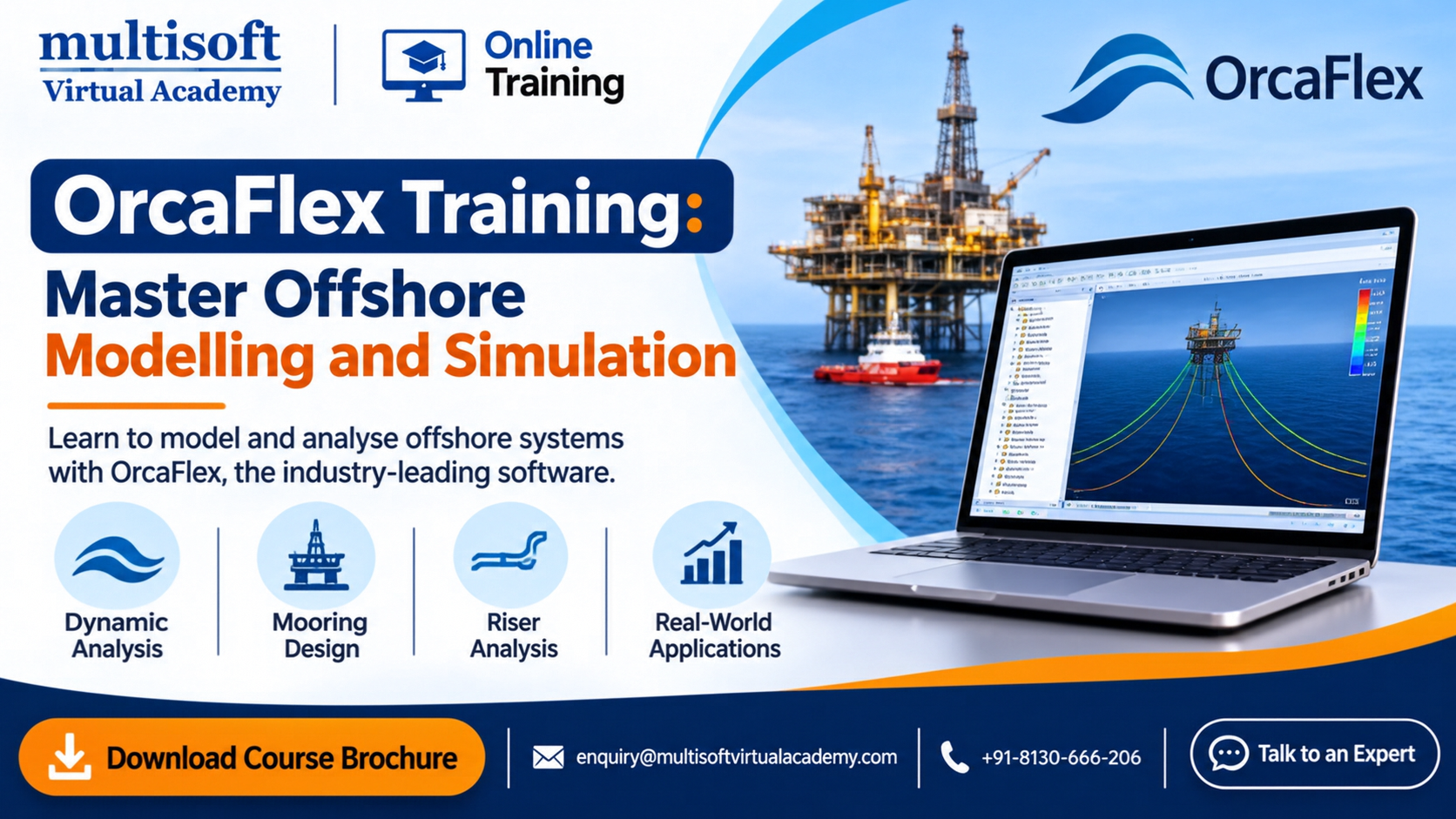
Offshore engineering requires detailed planning, accurate calculations, and reliable simulation methods. Marine structures and subsea equipment operate in challenging environments where waves, wind, currents, and vessel movements can influence their performance. Engineers must understand how these forces affect offshore systems before installation or operation begins.
OrcaFlex is a specialized engineering application used to model and analyse offshore and marine systems. It helps engineers investigate the behaviour of mooring lines, risers, subsea cables, flexible pipelines, vessels, and other connected components under different environmental conditions.
OrcaFlex Training provides an opportunity to develop practical knowledge of offshore modelling and simulation. Participants learn how to create engineering models, define environmental parameters, perform static and dynamic analysis, and interpret simulation results. These skills can be valuable for professionals working in offshore oil and gas, subsea engineering, marine operations, and renewable energy projects.
Developed by Orcina, OrcaFlex is a three-dimensional marine dynamics software package designed for analysing offshore systems. It allows engineers to represent different components of a marine system and investigate their behaviour under environmental and operational loading.
The software supports the modelling of interconnected structures and line-based systems. Engineers can define physical properties, environmental conditions, vessel movements, connections, and other parameters required for a simulation.
OrcaFlex is commonly associated with engineering activities such as:
Its simulation capabilities help engineering teams evaluate different operating conditions and understand the response of offshore systems.
Offshore projects involve several technical challenges that require careful engineering evaluation. Developing knowledge of specialized simulation software can help professionals understand these challenges and contribute more effectively to project activities.
Offshore structures consist of interconnected components that respond differently to environmental forces. Mooring lines, risers, vessels, and subsea equipment may experience changing loads and movements during operation.
OrcaFlex training introduces learners to the modelling of these components and their relationships. It helps participants understand how the behaviour of one component can influence the wider system.
Engineering simulations depend on appropriate model inputs and accurate representation of physical conditions. Learners become familiar with model geometry, material properties, connections, environmental data, and simulation settings.
This knowledge can help engineers develop more organized modelling workflows and identify possible input errors before performing detailed calculations.
Offshore engineering teams need to evaluate system performance under different operating conditions. Simulation studies can support design reviews by providing information about line tension, displacement, curvature, vessel movement, and other engineering responses.
Learning how to interpret these results helps professionals understand the role of simulation in design assessment.
Offshore installation work may involve vessels, lifting arrangements, subsea equipment, and complex deployment sequences. Engineers use analysis methods to investigate operational conditions and identify potential concerns.
Training introduces the modelling concepts that support these engineering assessments.
A structured OrcaFlex Course should explain the software interface, modelling methods, simulation processes, and engineering applications. The following modules provide a useful foundation for practical learning.
The learning process begins with understanding the OrcaFlex working environment. Participants explore the interface and learn how to organize models and manage different objects.
Topics may include:
These fundamentals help learners become comfortable with the software before progressing to advanced modelling activities.
Environmental conditions have a significant influence on offshore system behaviour. Engineers must represent relevant wave, wind, and current conditions when preparing simulation models.
Training may cover:
Understanding these inputs helps learners recognize how external forces influence offshore systems.
Vessel movement is an important consideration in offshore engineering. Floating structures may experience surge, sway, heave, roll, pitch, and yaw motions.
An OrcaFlex training program may introduce vessel modelling, reference positions, vessel data, motion specifications, and Response Amplitude Operators (RAOs).
These concepts help engineers represent vessel behaviour and study its influence on connected offshore components.
Mooring systems maintain the position of floating offshore structures. Their performance depends on line configuration, material characteristics, pretension, water depth, vessel movement, and environmental loading.
A practical OrcaFlex Mooring Analysis Training module may include:
These topics provide a foundation for understanding mooring system behaviour and evaluating engineering results.
Risers provide connections between floating offshore facilities and subsea infrastructure. They can experience different loading conditions because of vessel movement, waves, currents, internal contents, and seabed interaction.
Training may cover:
Understanding these parameters can help professionals involved in offshore riser engineering and subsea system analysis.
Subsea cables and umbilicals are important parts of offshore infrastructure. They provide electrical power, communication, control, and other services between offshore facilities and subsea equipment.
OrcaFlex training may explain how to represent these components using appropriate line properties and connections.
Learners may explore submerged weight, buoyancy, axial stiffness, bending stiffness, hydrodynamic loading, and seabed interaction.
This knowledge is relevant to professionals working on subsea cable installation and offshore renewable energy projects.
Static and dynamic analysis are important parts of offshore engineering simulation.
Static analysis establishes an equilibrium configuration based on the defined model and loading conditions. Dynamic analysis examines how a system responds over time to changing environmental or operational forces.
Training may introduce:
Learners should understand that selecting an appropriate analysis method depends on the engineering objectives and the physical behaviour being investigated.
Offshore installation projects involve activities such as lifting, lowering, towing, deployment, and positioning of marine equipment.
OrcaFlex can be used to model selected installation scenarios involving vessels, lines, winches, and subsea components.
A practical course may introduce installation configurations, line payout, lifting arrangements, vessel movement, and deployment sequences.
These concepts help learners understand how simulation studies can contribute to offshore operational planning.
Simulation outputs must be reviewed carefully before they are used in engineering decisions. Learners should understand how to examine the results and relate them to the original design objectives.
Important areas may include:
The ability to communicate simulation findings clearly is an important skill for offshore engineering professionals.
OrcaFlex supports engineering analysis across several industries that work with offshore and marine systems.
Offshore oil and gas: Engineers can use simulation models to evaluate mooring systems, risers, flexible pipes, and offshore installation arrangements.
Subsea engineering: The software supports modelling activities involving subsea cables, umbilicals, pipelines, and other connected components.
Marine operations: Marine engineers can investigate vessel-related systems, towing configurations, and selected offshore operating conditions.
Offshore renewable energy: Floating wind systems involve complex interactions between floating structures, mooring arrangements, and environmental forces. Simulation can support the assessment of these systems.
Naval architecture: Vessel movement and hydrodynamic response are important considerations in marine engineering studies.
Offshore construction: Installation contractors and engineering teams may use simulation studies to evaluate lifting and deployment scenarios.
The specific application depends on the project requirements, model assumptions, and engineering methodology.
An OrcaFlex Online Training Course can be useful for professionals who want to develop their knowledge of offshore modelling and marine dynamics.
A basic understanding of engineering mechanics, structural behaviour, and marine systems can make the learning process easier. Beginners should choose a program that covers software fundamentals before introducing advanced analysis techniques.
Specialized simulation skills can complement an engineering qualification and support professional development in offshore and marine engineering.
Depending on educational background and experience, relevant career paths may include:
| Job Role | Related Responsibilities |
| Offshore Analysis Engineer | Offshore system modelling and simulation |
| Mooring Analysis Engineer | Mooring configuration and line response assessment |
| Riser Engineer | Riser modelling and structural response evaluation |
| Subsea Engineer | Subsea equipment and connected system analysis |
| Marine Engineer | Marine system modelling and operational studies |
| Offshore Installation Engineer | Installation planning and simulation |
| Pipeline Analysis Engineer | Offshore pipeline and flexible line assessment |
| Naval Architect | Vessel-related engineering and hydrodynamic studies |
Employers generally consider practical experience, engineering fundamentals, software proficiency, and project knowledge when evaluating candidates. Completing training does not automatically qualify someone for every specialist role, but it can provide useful technical preparation.
Choosing an appropriate training program is important for gaining useful software and engineering knowledge. Before enrolling, consider these points.
Ensure that the syllabus includes relevant subjects such as model development, environmental loading, line properties, vessel modelling, static analysis, dynamic simulation, and results evaluation.
Practical exercises help learners understand how theoretical concepts are applied in software. Choose a program that includes representative offshore engineering scenarios.
An instructor should have relevant knowledge of OrcaFlex and offshore engineering applications. The ability to explain modelling assumptions and simulation results is especially valuable.
Ask whether software access is included and which version will be used during the course. This helps participants understand the practice environment before joining.
Live online sessions, one-to-one instruction, and self-paced learning offer different advantages. Select a format that matches your schedule and learning requirements.
Review the expected learning outcomes and confirm whether the program focuses on general software knowledge or specific areas such as mooring analysis, riser modelling, or offshore installation.
OrcaFlex is used to model and analyse offshore and marine systems, including mooring lines, risers, vessels, subsea cables, umbilicals, and flexible pipelines.
Common topics include software navigation, model creation, environmental conditions, vessel modelling, line properties, mooring analysis, riser modelling, static calculations, dynamic simulations, and results interpretation.
Yes. Beginners can start with the software interface and basic model development. Knowledge of engineering mechanics and offshore system fundamentals is helpful.
Yes. OrcaFlex supports nonlinear time-domain dynamic analysis, which allows engineers to investigate system behaviour over a defined simulation period.
Yes. It can support the modelling and analysis of floating offshore wind systems, including mooring arrangements and connected marine components.
A basic understanding of engineering mechanics, marine systems, and structural behaviour is useful. It is also important to check the course syllabus and software access arrangements.
Offshore engineering projects require reliable modelling methods to evaluate the behaviour of marine structures and connected systems under complex environmental conditions. Developing expertise in OrcaFlex can help professionals understand vessel dynamics, mooring configurations, riser behaviour, subsea systems, and offshore installation simulations. A practical learning approach that combines software exercises with engineering concepts can strengthen technical knowledge and improve confidence in simulation workflows. Multisoft Virtual Academy provides OrcaFlex Training for engineering professionals who want to develop their capabilities in offshore modelling, marine dynamics, mooring analysis, riser simulation, and subsea engineering through structured instructor-led learning.
| Start Date | End Date | No. of Hrs | Time (IST) | Day | |
|---|---|---|---|---|---|
| No schedule available ! | |||||
Schedule does not suit you, Schedule Now! | Want to take one-on-one training, Enquiry Now! |
|||||




 Join our Live Instructor-Led online classes delivered by industry experts
 Let's Get Started
