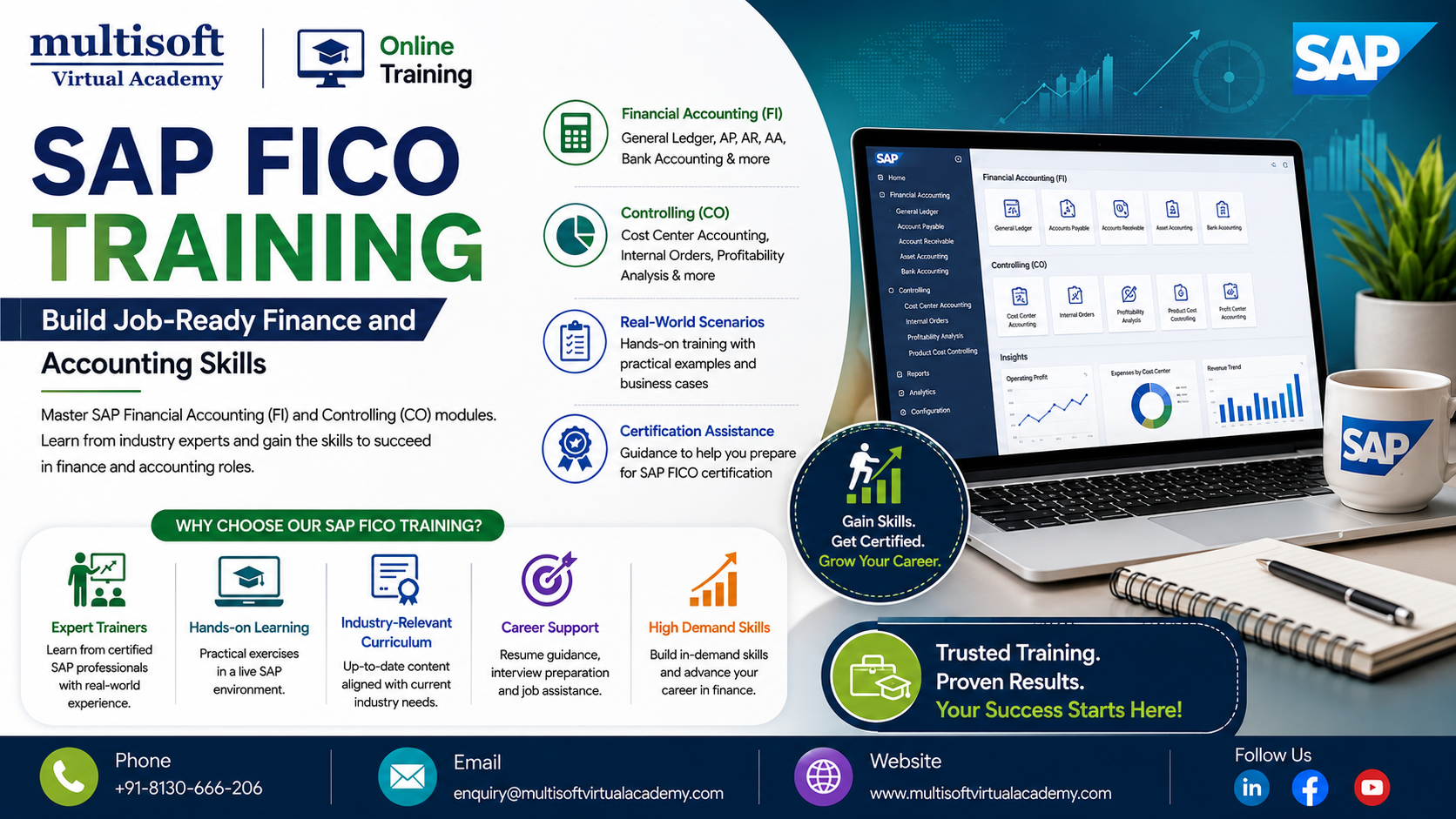
SAP FICO remains one of the most valuable ERP skill areas for finance professionals, accountants, SAP consultants and business users who want to work with enterprise financial management systems. As organizations continue moving from traditional SAP ERP environments toward SAP S/4HANA, demand is increasingly shifting toward professionals who understand both SAP FI and SAP CO along with modern S/4HANA finance processes.
SAP FICO training stands for SAP Financial Accounting (FI) and Controlling (CO). It is a core functional area used to manage financial transactions, accounting processes, cost management, profitability analysis and financial reporting.
SAP FI focuses primarily on external financial accounting. It supports processes such as General Ledger, Accounts Payable, Accounts Receivable, Asset Accounting, Bank Accounting and financial closing.
SAP CO focuses on internal management accounting. It helps organizations monitor costs, analyze profitability, manage cost centers and support planning and decision-making.
Together, FI and CO create an integrated financial management environment in which financial transactions can be recorded, analyzed and reported efficiently.
The importance of this knowledge is increasing as SAP S/4HANA brings together transactions, analytics and automation across finance processes. SAP's current learning resources also emphasize areas such as accounting, cost management, reporting, treasury and group reporting.
Finance departments are becoming increasingly technology-driven. Companies no longer rely only on spreadsheets and traditional accounting applications for complex financial operations. They need integrated ERP platforms capable of supporting multiple entities, currencies, regulatory requirements, business processes and real-time reporting.
This transformation has increased the importance of SAP FICO training for professionals who want to combine accounting expertise with SAP technology.
A structured SAP FICO course can help learners understand how business requirements are translated into SAP processes and configurations. It can also provide practical exposure to financial transactions, organizational structures, master data, reporting and integration.
For experienced professionals, SAP S/4HANA Finance training can be particularly valuable because modern SAP finance environments extend beyond traditional FI/CO concepts.
A common question among beginners is the difference between SAP FI and SAP CO.
SAP FI is concerned with recording and reporting financial transactions. Important areas include:
SAP's current Financial Accounting learning paths specifically cover organizational units and master data, General Ledger, Accounts Payable, Accounts Receivable, Asset Accounting, period-end and year-end closing and reporting.
SAP CO focuses on internal financial management and cost analysis. It can include:
The combination of FI and CO allows organizations to connect financial accounting with management accounting and gain a broader view of financial performance.
The phrase "SAP FICO" is still widely used when people search for finance and controlling skills, but professionals should also understand SAP S/4HANA Finance.
SAP S/4HANA is the modern ERP environment in which finance processes are increasingly integrated with real-time analytics, automation and broader business operations. SAP describes S/4HANA Cloud as an ERP platform designed around integrated business processes and a digital core.
Therefore, an effective SAP FICO training course should not focus exclusively on legacy SAP ECC transactions. Learners should also understand how finance processes operate in SAP S/4HANA.
SAP's current training portfolio includes dedicated learning paths for Financial Accounting in SAP S/4HANA as well as SAP S/4HANA Cloud Public Edition and Private Edition.
A comprehensive SAP FICO course should combine conceptual knowledge, configuration understanding and business-process practice.
Learners should understand important organizational elements such as:
Understanding these structures is essential because they determine how financial information is recorded and reported.
General Ledger is one of the most important areas of SAP Financial Accounting. Training generally introduces:
Strong knowledge of General Ledger provides the foundation for understanding other SAP FI processes.
Accounts Payable manages transactions involving vendors and suppliers.
An SAP FICO training program can cover vendor master data or the relevant business partner approach, invoice processing, outgoing payments, payment configuration, reconciliation accounts, automatic payment processes and vendor reporting.
Accounts Receivable focuses on customer-related financial transactions.
Important concepts include:
Asset Accounting helps organizations manage financial information related to fixed assets.
Training can introduce:
The controlling component helps organizations understand where money is being spent and how costs affect business performance.
Professionals may learn:
SAP's current Finance documentation also highlights management accounting and margin analysis as important capabilities for planning, resource allocation and strategic performance management.
One of the biggest advantages of learning SAP FICO is understanding integration.
Financial transactions rarely exist in isolation. Procurement, sales, production, inventory and human resources processes can generate financial impacts.
For example, a procurement transaction can eventually create an accounting impact when goods or services are received and invoices are processed. Similarly, a sales transaction can generate accounting entries related to customer receivables and revenue.
SAP FICO professionals may therefore benefit from understanding integration with:
This cross-functional understanding can make a consultant more effective during implementation and support projects.
SAP FICO certification is frequently searched by professionals who want to validate their SAP finance knowledge. However, certification preparation should be approached as part of a broader learning strategy rather than as a replacement for practical knowledge.
SAP currently provides learning journeys and certification-oriented training for Financial Accounting in SAP S/4HANA Cloud. Its official learning resources state that certification-oriented programs can cover implementation tasks, financial accounting master data, General Ledger, Accounts Payable, Accounts Receivable, Asset Accounting, closing and reporting.
For professionals moving toward S/4HANA Cloud, it is therefore useful to understand the difference between general SAP FICO knowledge and product-specific certification requirements.
SAP FICO training can be useful for several professional groups:
Finance and Accounting Professionals:
Accountants and finance executives can learn how their existing accounting knowledge is represented within an ERP environment.
SAP Beginners:
Graduates and professionals entering the SAP ecosystem can use FI/CO fundamentals as a starting point for a functional SAP career.
Experienced SAP Consultants:
Professionals with SAP ECC experience can strengthen their knowledge of S/4HANA Finance and modern financial processes.
Business Analysts:
Those working between business and technology teams can improve their understanding of finance processes and SAP requirements.
Managers and Finance Leaders:
Decision-makers can gain a clearer understanding of ERP-enabled financial reporting, cost management and business process integration.
Online learning has become an attractive option for professionals who cannot attend traditional classroom sessions.
A well-designed SAP FICO online training program can provide instructor-led sessions, demonstrations, practical exercises, business scenarios, assignments and interactive discussions.
For working professionals, online SAP training can offer greater flexibility while still maintaining structured learning.
However, learners should evaluate a course based on its practical depth rather than simply choosing a program because it is advertised as an "SAP FICO online course."
Important factors include:
SAP finance skills can support several career paths depending on experience, accounting knowledge and technical specialization.
Potential roles include:
Career progression generally depends on more than course completion. Practical project experience, business-process knowledge, communication skills, configuration expertise and familiarity with current SAP technologies can significantly influence professional growth.
To become a stronger SAP finance professional, learners should consider developing several complementary skills.
Accounting Fundamentals:
A solid understanding of accounting principles makes SAP FI concepts easier to understand.
Business Process Knowledge:
Knowing how businesses manage procure-to-pay, order-to-cash and record-to-report processes helps consultants understand requirements.
Configuration Knowledge:
Functional consultants need to understand how SAP settings influence business processes.
Integration Knowledge:
Understanding how FI/CO interacts with MM, SD and other modules can be highly valuable.
Analytical Skills:
Finance professionals increasingly work with reporting, analytics and performance information.
Communication Skills:
SAP consultants often work with finance teams, technical teams, project managers and business stakeholders. Clear communication is therefore essential.
The future of SAP finance is moving toward integrated, automated and data-driven processes. SAP's current finance learning resources emphasize automation, real-time financial information, analytics and integrated finance processes.
This means professionals should avoid treating SAP FICO as a collection of transaction codes alone.
Instead, learners should understand the complete business process:
Business Requirement ? Process Design ? SAP Configuration ? Transaction Processing ? Integration ? Reporting ? Analysis
This approach helps professionals develop practical problem-solving abilities rather than simply memorizing SAP screens.
Before enrolling in an SAP FICO course, compare the curriculum against your career objective.
If you are a beginner, start with accounting fundamentals, SAP navigation, organizational structures and core FI processes.
If you are an experienced finance professional, focus on configuration, integration, reporting and S/4HANA Finance.
If you are an existing SAP consultant, consider advanced S/4HANA topics, implementation methodology, cloud finance and certification preparation.
For professionals targeting implementation roles, SAP's current learning paths demonstrate the importance of understanding configuration and core implementation activities rather than only end-user transactions.
SAP FICO continues to be a strong career-oriented skill for professionals who want to connect finance, accounting and enterprise technology. The growing importance of SAP S/4HANA Finance, cloud ERP, automation, analytics and integrated financial processes makes continuous learning increasingly important. A focused SAP FICO Training program can help learners build a foundation in Financial Accounting and Controlling while developing the practical understanding required for modern SAP finance environments. For professionals seeking structured learning, practical exposure and career-focused SAP finance education, Multisoft Virtual Academy provides SAP training solutions designed to support learners in developing relevant functional and implementation-oriented skills.
| Start Date | End Date | No. of Hrs | Time (IST) | Day | |
|---|---|---|---|---|---|
| 10 Oct 2026 | 01 Nov 2026 | 24 | 06:00 PM - 09:00 PM | Sat, Sun | |
| 11 Oct 2026 | 02 Nov 2026 | 24 | 06:00 PM - 09:00 PM | Sat, Sun | |
Schedule does not suit you, Schedule Now! | Want to take one-on-one training, Enquiry Now! |
|||||






 Join our Live Instructor-Led online classes delivered by industry experts
 Let's Get Started