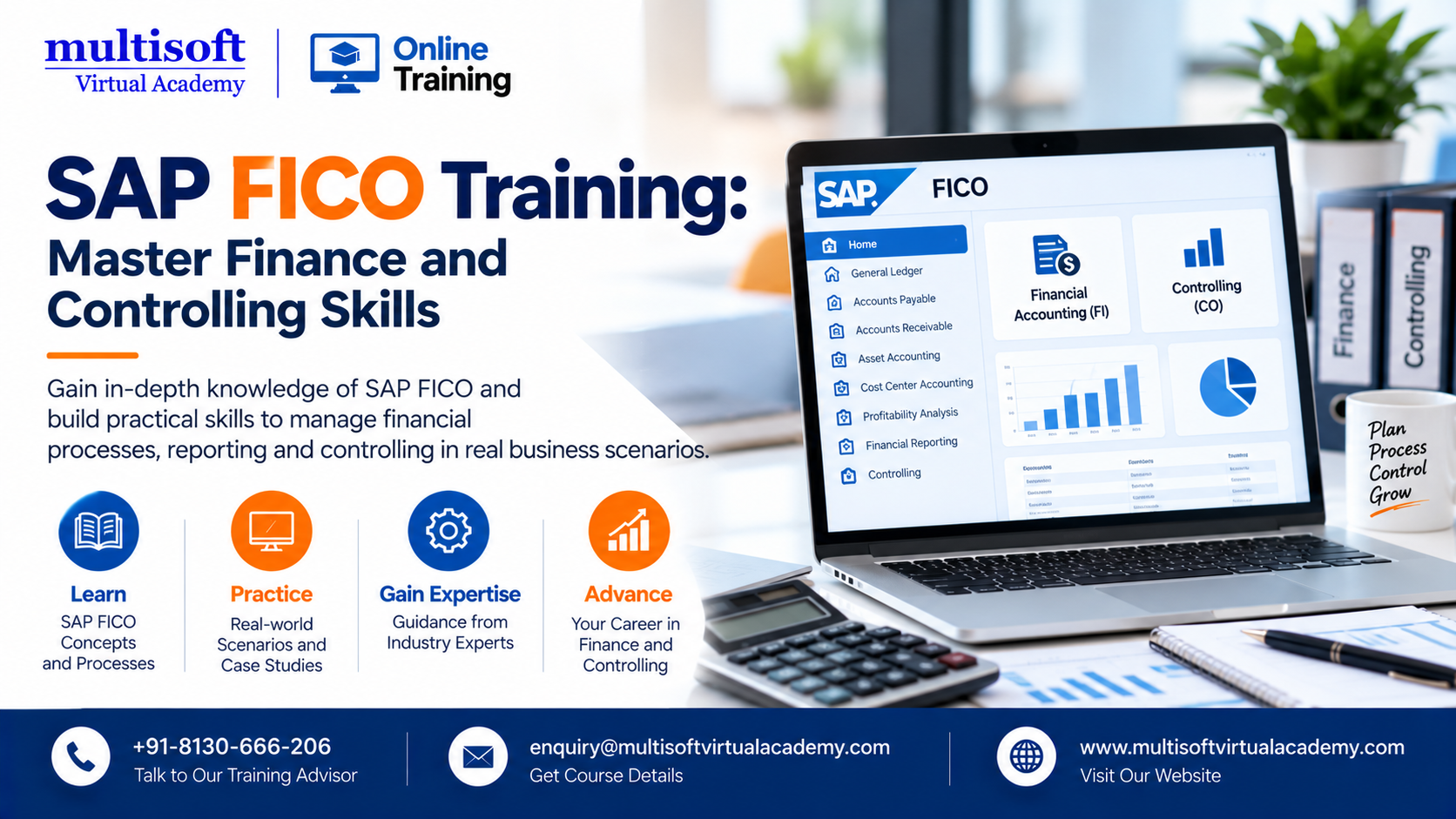
As organizations continue to modernize finance operations, professionals who understand enterprise financial systems are becoming increasingly valuable. SAP FICO Training provides a structured pathway to develop expertise in Financial Accounting (FI) and Controlling (CO), two important areas used to manage financial transactions, reporting, costs, profitability, and internal business processes.
For finance professionals, accountants, consultants, graduates, and ERP specialists, learning SAP FICO Training can bridge the gap between traditional accounting knowledge and modern enterprise technology. The learning path becomes even more relevant when it includes SAP S/4HANA Finance Training, practical configuration, business scenarios, integration concepts, and implementation-oriented exercises.
SAP’s current finance learning ecosystem emphasizes Financial Accounting, Management Accounting, SAP S/4HANA, implementation skills, and certification-oriented learning.
SAP FICO traditionally combines two major functional areas: SAP FI (Financial Accounting) and SAP CO (Controlling).
SAP FI focuses primarily on external and statutory financial accounting processes. It supports areas such as General Ledger Accounting, Accounts Payable, Accounts Receivable, Asset Accounting, financial closing, and financial reporting.
SAP CO focuses more heavily on internal management and cost control. It helps organizations understand where money is being spent, how different business units are performing, and how costs and profitability can be analyzed for better decision-making.
Together, these areas provide finance professionals with a comprehensive view of organizational financial activities.
For modern learners, however, SAP FICO knowledge should not stop with traditional concepts. SAP S/4HANA Finance has become an important part of the learning journey, making S/4HANA-oriented finance and implementation skills highly relevant.
Finance departments today are expected to do much more than record transactions. Organizations want faster reporting, stronger financial controls, automation, accurate forecasting, improved compliance, and better access to business insights.
Modern SAP finance solutions support capabilities spanning accounting and financial close, finance operations, planning and analysis, compliance, treasury, cash management, and data-driven decision-making. SAP also highlights automation and AI-driven processes as part of its current Cloud ERP finance capabilities.
This makes SAP FICO Training useful for professionals who want to understand how financial processes operate inside a large ERP environment.
Rather than learning accounting processes in isolation, participants can understand how financial transactions connect with procurement, sales, inventory, assets, cost management, reporting, and other business functions.
SAP FI Training is an essential part of the overall SAP FICO learning path. It introduces learners to the structure and processes required to manage financial accounting activities within an SAP environment.
A practical SAP FI course commonly focuses on areas such as organizational structures, company codes, fiscal years, currencies, chart of accounts, document structures, posting controls, and master data.
Learners can then progress toward important financial processes, including:
SAP’s Financial Accounting learning journey specifically covers organizational units and master data, General Ledger, Accounts Payable, Accounts Receivable, Asset Accounting, period and year-end close, and reporting.
Understanding these concepts helps learners see how everyday accounting activities are configured, processed, monitored, and reported within an enterprise ERP system.
While FI addresses core financial accounting, SAP CO Training develops knowledge of internal cost management and performance analysis.
Businesses need to understand not only how much they earn or spend, but also where those costs originate and how individual departments, projects, products, or activities contribute to overall performance.
This is where controlling becomes important.
An SAP CO learning path may cover concepts such as:
Cost Center Accounting: Helps organizations assign and monitor costs associated with departments or functional areas.
Profit Center Accounting: Supports analysis of financial performance across different responsibility areas.
Internal Orders: Helps monitor costs associated with specific internal activities, initiatives, or short-term projects.
Product Cost Controlling: Supports the understanding and analysis of costs associated with producing goods and services.
Profitability Analysis: Helps evaluate business performance from profitability-oriented perspectives.
Developing both FI and CO knowledge gives learners a broader understanding of financial accounting and managerial decision-making.
Anyone considering SAP FICO Training today should also pay attention to SAP S/4HANA Finance Training.
SAP’s S/4HANA training portfolio includes Financial Accounting, Management Accounting, integration, and cloud finance learning paths. SAP also provides implementation-focused learning specifically for configuring Financial Accounting in SAP S/4HANA.
This shift makes several related learning areas particularly valuable:
SAP S/4HANA Finance Training
SAP S/4HANA Financial Accounting Training
SAP S/4HANA Management Accounting Training
SAP Finance Implementation Training
SAP FICO S/4HANA Training
Professionals who already have experience with traditional SAP FI/CO can use S/4HANA-focused learning to update their knowledge, while beginners can benefit from understanding modern finance processes from the beginning.
A well-designed SAP FICO Training Course should move beyond definitions and theoretical concepts. Learners benefit most when accounting knowledge is connected with configuration and realistic business processes.
The learning journey can begin with SAP fundamentals and organizational structures before progressing into financial configuration.
Important skills may include configuring company codes, defining fiscal year variants, understanding posting periods, managing charts of accounts, creating financial master data, processing transactions, handling customer and vendor accounting, and understanding asset-related processes.
On the controlling side, learners can develop knowledge of cost centers, profit centers, internal orders, cost elements, allocations, planning, and profitability-related processes.
More advanced learning should also explain how financial accounting interacts with other SAP functional areas.
One reason SAP FICO skills are valuable is the high level of integration involved in enterprise processes.
A purchase transaction, for example, may originate from procurement activities but eventually create a financial impact. Similarly, a sales process can result in customer receivables, revenue postings, taxes, and profitability-related information.
For this reason, SAP finance professionals benefit from understanding integration areas such as:
SAP FI-MM Integration: Connects procurement and material-related transactions with financial accounting.
SAP FI-SD Integration: Connects sales and billing activities with financial postings.
FI-CO Integration: Connects financial transactions with internal cost and management accounting.
Asset Accounting Integration: Helps organizations maintain and account for fixed assets throughout their lifecycle.
Learning these relationships helps participants understand complete business processes rather than viewing SAP FI and CO as isolated modules.
Reading about SAP concepts can provide a foundation, but practical exposure is essential for developing job-oriented skills.
A learner may understand what a company code is from a textbook, but practical exercises help explain how organizational structures are configured and used. The same applies to General Ledger accounts, vendor and customer transactions, asset accounting, cost centers, posting periods, and financial reports.
Hands-on SAP FICO Online Training can help participants connect three important elements:
Business Requirement ? SAP Configuration ? Business Transaction
This approach is particularly useful for aspiring consultants because implementation work requires professionals to understand business requirements and determine how those requirements should be represented within an SAP system.
SAP itself includes hands-on practice and instructor-led options within its broader learning ecosystem, reflecting the importance of practical learning alongside conceptual knowledge.
Learning how to use an SAP transaction is different from learning how to participate in an implementation.
SAP FICO Implementation Training can introduce learners to the broader lifecycle of an ERP project.
This may include understanding business requirements, mapping existing processes, identifying gaps, configuring financial processes, preparing master data, testing transactions, supporting user acceptance testing, assisting with migration activities, documenting processes, and supporting go-live activities.
Implementation-oriented knowledge is especially valuable for learners interested in becoming SAP functional consultants.
SAP’s current S/4HANA Financial Accounting learning journey similarly focuses on the knowledge and technical skills required to participate in implementation project tasks and configure core Financial Accounting processes.
SAP FICO Certification Training is another popular learning path for professionals who want to validate their SAP knowledge.
Certification preparation should not simply focus on memorizing questions. A stronger approach is to understand the underlying business processes, configuration concepts, terminology, dependencies, and practical scenarios associated with the relevant SAP certification.
SAP currently offers certification and learning resources alongside instructor-led and self-paced options. Its learning environment includes SAP Learning Hub and certification-focused pathways designed to develop and validate SAP skills.
Because SAP certification offerings can evolve, candidates should always verify the current certification title, exam requirements, learning journey, and applicable product version before preparing for an exam.
SAP FICO Training can be suitable for professionals from different educational and career backgrounds, particularly those interested in finance, accounting, ERP systems, consulting, or enterprise transformation.
Typical learners include finance professionals, accountants, commerce graduates, MBA Finance graduates, ERP users, SAP end users, functional consultants, business analysts, implementation team members, and professionals transitioning into SAP careers.
Existing SAP professionals may also study S/4HANA Finance to modernize their skills.
Prior accounting knowledge can make certain concepts easier to understand, particularly debit and credit principles, financial statements, accounts payable, accounts receivable, assets, and cost accounting. However, a structured beginner-friendly learning path can introduce these concepts progressively.
Developing SAP FICO expertise can support multiple career directions depending on a learner’s previous experience, domain expertise, SAP knowledge, certification, and project exposure.
Potential roles include:
SAP FICO Consultant, SAP FI Consultant, SAP CO Consultant, SAP S/4HANA Finance Consultant, SAP Finance Functional Consultant, SAP Support Consultant, ERP Finance Analyst, SAP Business Analyst, and SAP Finance End User.
Professionals with strong accounting knowledge and practical SAP skills may also progress toward implementation, support, migration, testing, solution consulting, and finance transformation roles.
It is important to remember that completing a course alone does not guarantee a particular job or salary. Career outcomes depend on practical competence, experience, location, industry demand, communication skills, certifications, and the ability to solve real business problems.
Beginners often wonder whether SAP FICO is difficult to learn.
The subject becomes much easier when studied in a logical sequence.
A learner can begin with ERP and SAP fundamentals, followed by basic accounting concepts and SAP organizational structures. The next stage can cover General Ledger, Accounts Payable, Accounts Receivable, Asset Accounting, and core controlling processes.
After establishing these fundamentals, learners can move toward integration, configuration, reporting, S/4HANA Finance, implementation scenarios, and certification preparation.
SAP also provides introductory Financial Accounting learning designed to help newcomers understand areas such as record-to-report, Accounts Payable, Accounts Receivable, and Asset Accounting.
Not every SAP FICO Online Training Course provides the same learning experience.
Before enrolling, learners should evaluate whether the program offers an updated curriculum, experienced instructors, practical exercises, S/4HANA Finance coverage, implementation-oriented scenarios, certification guidance, and opportunities to clarify technical questions.
A useful course should explain not just what to do in SAP but also why a configuration or transaction is required.
This distinction is important.
Professionals working on real projects are often expected to analyze business requirements rather than simply follow predefined steps. Therefore, scenario-based learning and practical problem-solving can be much more valuable than memorizing transaction codes.
The finance function is becoming increasingly connected with automation, analytics, cloud ERP, and AI-supported processes.
SAP’s current Cloud ERP finance capabilities emphasize real-time information, automated accounting processes, predictive analytics, AI-assisted finance activities, compliance, cash management, and financial planning.
For learners, this means SAP FICO knowledge should continue evolving.
Core accounting concepts remain essential, but professionals can strengthen their profiles by developing knowledge of SAP S/4HANA Finance, SAP Cloud ERP Finance, financial analytics, automation, integration, implementation, and modern reporting.
The strongest learning strategy is therefore not to treat SAP FICO as a one-time certification subject. It should be approached as a broader professional skill set combining accounting expertise, ERP knowledge, configuration ability, analytical thinking, and business-process understanding.
SAP FICO Training can provide a strong learning pathway for professionals who want to combine finance and accounting expertise with modern enterprise technology. From Financial Accounting and Controlling to SAP S/4HANA Finance, implementation, integration, reporting, and certification preparation, the right training can help learners develop skills that are relevant to real-world SAP environments.
Multisoft Virtual Academy provides SAP FICO Training designed to help learners strengthen their understanding through expert-led sessions, practical learning, and industry-oriented concepts. Whether you are a finance professional, beginner, SAP user, or aspiring functional consultant, structured training can help you progress from fundamental concepts toward more advanced SAP finance skills.
| Start Date | End Date | No. of Hrs | Time (IST) | Day | |
|---|---|---|---|---|---|
| 10 Oct 2026 | 01 Nov 2026 | 24 | 06:00 PM - 09:00 PM | Sat, Sun | |
| 11 Oct 2026 | 02 Nov 2026 | 24 | 06:00 PM - 09:00 PM | Sat, Sun | |
Schedule does not suit you, Schedule Now! | Want to take one-on-one training, Enquiry Now! |
|||||






 Join our Live Instructor-Led online classes delivered by industry experts
 Let's Get Started